

You know the scene: someone in your circle of friends buys a fitness tracker, and the first week turns into a festival of disillusionment: resting heart rate higher than expected, 4,300 steps instead of the felt ten thousand, sleep quality “needs improvement”. The first impulse: back into the drawer with the thing. The second is the better one: find a goal that matches the numbers. Not the marathon they have been talking about for years, but ten kilometres under an hour, in October. Plus a training plan that closes exactly the gap between today and October.
Measure, set a goal, train. Three steps so banal they would hardly be worth a blog post. If companies did not skip them constantly the moment data and AI are involved.
Because there, things surprisingly often run the other way round: first the goal gets announced, preferably in the order of magnitude of “we are going AI-first”, then tools get bought, and the question of where you actually stand is asked by no one. That is the marathon registration without a single glance at your resting heart rate. Sports medicine has a sober word for it: risk of injury.
Two axes, four quadrants
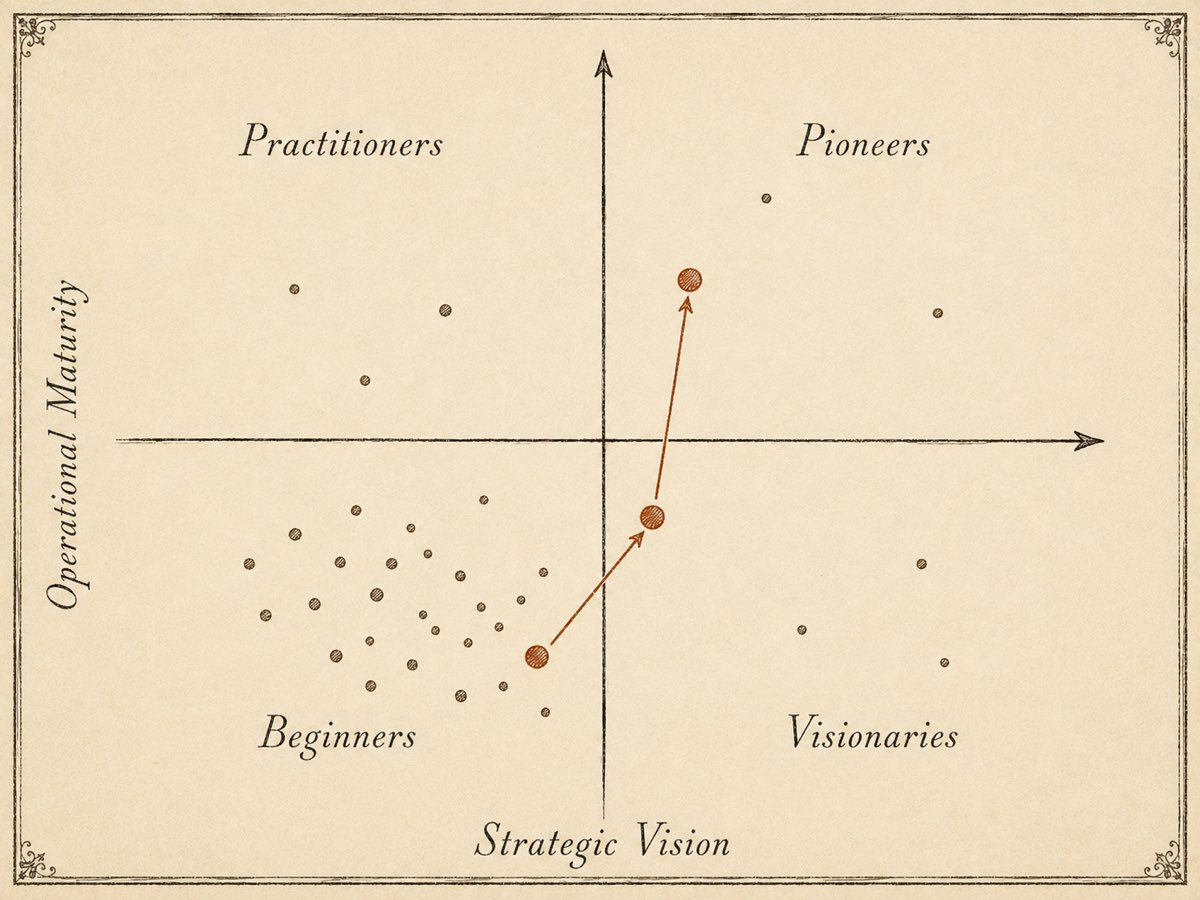
The tool I use to structure these three steps in strategy projects is called the Strategic Quadrant. It contrasts two questions that get mixed up all the time in everyday business.
The vertical axis measures operational maturity: does your company have the skills, tools and structures to use data reliably and efficiently? That is your basic endurance, your resting heart rate, your running technique. The horizontal axis measures strategic vision: do data support and drive your business, from alignment on shared goals to use as a differentiator? Translated: do you know what you are training for?
The two axes produce four fields. Beginners have neither base nor goal; that is the sofa. Practitioners train with discipline but without a race in the calendar: reporting runs, the numbers are right, yet data remains a cost centre rather than a business driver. Visionaries have already printed their race number – only the basic endurance is missing: big AI ambitions on a shaky data foundation. Since generative AI reached every board agenda, this has been, in my experience, the quadrant with the strongest influx. And pioneers train systematically towards a clear goal; every session pays into it.
The picture also includes everyone else’s dots: in the assessment we place not only your own company but also the market environment. So you see not just your own pulse but also where your peer group is currently running.
Step 1: Measure instead of guessing
Self-assessment flatters. Ask ten people whether they get enough exercise and you get eight yeses. Ask the tracker and it becomes two. Companies are no different: hardly a management team that does not consider its data usage solid to above average in the first conversation.
That is why every data and AI strategy starts with an honest gap assessment: both axes, collected in a structured way, across business departments and IT rather than just the data team. The most interesting insights sit in the contradictions. When sales considers its data reliable and controlling audibly inhales at the same question, you have just learned more about your operational maturity than from any questionnaire. And the AI side belongs on the scales explicitly: which capabilities are already in use? Which data would carry them? How much decision-making should a system be allowed to take over today in the first place?
Step 2: Not everyone needs to be a pioneer
This is where the quadrant differs from the usual maturity models, and I consider precisely this difference its greatest value. A maturity model knows only one direction: level five is better than level three, so everyone is supposed to move up. That is as if every training plan in the world led to the same marathon. The quadrant separates ability from ambition and thereby makes modest goals legitimate.
An example, told generically: a grown mid-sized company, data silos along system boundaries, no unified master data management, plenty of manual work in analysis. The honest target picture was practitioner, not pioneer: consolidated data, reliable company-wide steering, AI efficiency gains in document processing. Because this business model differentiates through product quality and customer relationships, not through data. Ten kilometres under an hour is an excellent goal if your business does not demand a marathon. The goal comes from the business, not from the benchmark. Business leads, technology enables, including on how high to aim.
Step 3: Finding the path
Look at the target path in almost any filled-in quadrant and something stands out: it rarely runs diagonally. It goes up first and then to the right, operational maturity first, then vision fulfilled. That is not caution, that is training doctrine: basic endurance before speed work. The visionary use cases, and those are almost always the AI-heavy ones, stand on a foundation of integrated data, clean master data and clear responsibilities. Reverse the order and you get the classic beginner’s injury: the expensive pilot that lives in the demo folder, and business departments that wave off wearily at the next attempt.
The training plan itself is then mostly prioritisation: not twenty construction sites at once, but the steps that close your gap. Getting from beginner to practitioner takes different sessions than the visionary needs who only lacks the foundation. That is exactly why the gap assessment is the first building block of Horizon 1 – Strategic Foundation: know your starting point, define a realistic goal, set the path in between.
The asterisks and the glance at your wrist
Three caveats belong on the table. First: two axes are a simplification. The quadrant is an alignment instrument, not a precision gauge; whether your dot sits two millimetres further left is not worth a discussion. Its job is to get the board and the business departments looking at the same picture for the first time. Second: it does not tell you which use cases deliver the value. The fitness check is no substitute for training; for the content there is the Potential Map and the prioritisation behind it. Third, and this is the one most often forgotten: the positioning is a snapshot. It gets worked out once in the project and kept current afterwards. Your organisation changes, and the dots around you keep training; an assessment from three years ago describes the fitness of a different company. After all, the device on your wrist is called a tracker, not a photo.
And if the story from the beginning ends well, it looks like this: the tracker is still being worn. The October run is yet to come, but the resting heart rate is down ten beats, and the marathon is back in conversation: maybe in two years, once the base carries it. That is not a smaller ambition. It is the same ambition, honestly scheduled.
The same goes for your company. Measure first. Then choose the right race. Then train.