

A lightning bolt is an impressive piece of energy. Depending on the bolt and on who is doing the maths, a single discharge carries a few hundred kilowatt-hours, enough to fully charge an electric car several times over or to power a household for weeks. And yet nowhere in the world is there a power plant that harvests lightning. Not because nobody thought of it; there have been experiments and patents aplenty. But because a lightning bolt has everything except what makes energy valuable: it cannot be planned, cannot be controlled, and is over in milliseconds. Current certainly flows, more than in any power plant — but no appliance is connected, and so all that work dissipates as heat, light and thunder. Gigantic potential, a spectacular discharge, and zero kilowatt-hours on your electricity bill.
Why am I telling you this? Because in almost every strategy meeting, sooner or later, someone says: “There is enormous potential in our data.” The sentence is probably even true. But on its own it has the same market value as a thunderstorm on the horizon.
Physics takes the word potential literally, and that is worth doing here: a potential, more precisely a potential difference, is a voltage that is applied. The power that actually arrives is voltage times current. As long as no current flows, the finest voltage delivers exactly zero watts. And even when current does flow, the lightning bolt has just demonstrated it, nothing arrives without a consumer at the end. A potential does no work. Only a closed circuit with an appliance in it does.
That is exactly what the use-case-driven approach is about: the journey from applied voltage to flowing current, in three stations.
Voltage, circuit diagram, appliance: the three stations
A potential is the voltage that is applied. “Our customer retention is ten per cent behind the industry average” is such a sentence: strategically relevant, undeniably important, and entirely without a solution. That is not a weakness; it is the definition. A potential describes where value lies dormant, not how it gets lifted. Whoever stops at this point, though, has only photographed the thunderstorm.
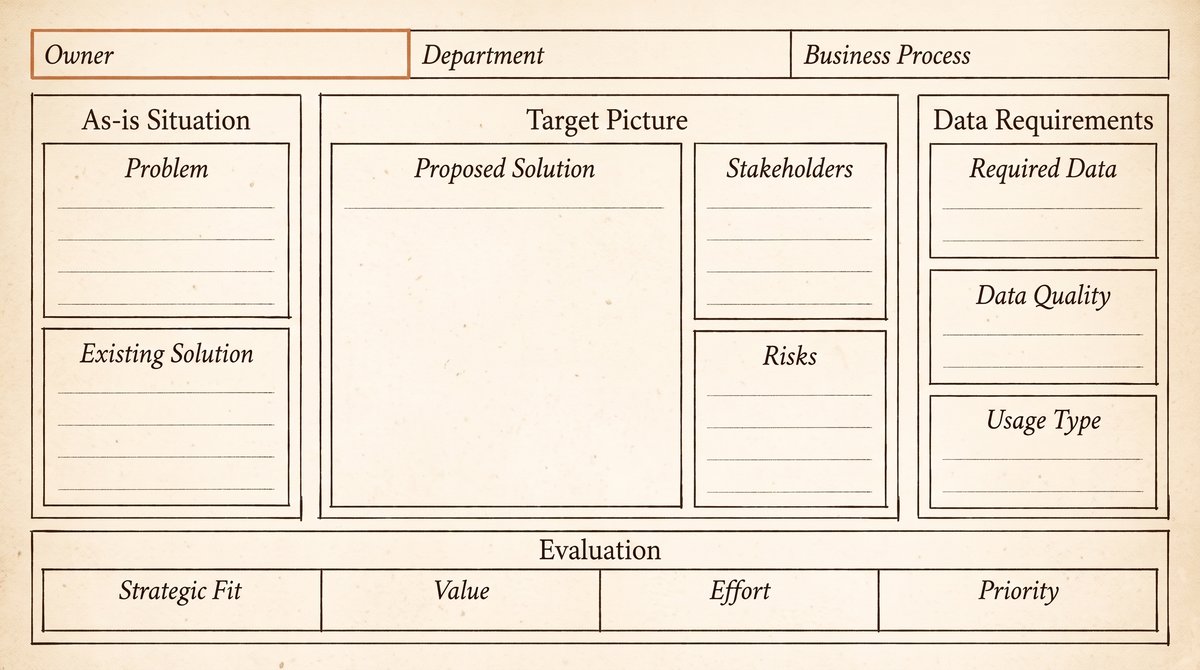
A use case is the circuit diagram. It translates the voltage into a concrete circuit: which consumer is connected, which current should flow, how do we measure it? “Retention behind the average” suddenly turns into very concrete initiatives. Spotting churners before they churn, with a forecasting model that raises its hand weeks before the exit. The most effective win-back offer per customer segment, proposed by a model, approved by a human. Watching campaign impact live instead of in the quarterly review. All three, by the way, are AI initiatives, and all three answer the most honest question of all up front: how much decision-making are we handing over, and who signs off?
A good use case is a profile rather than a paragraph of prose: problem, target picture, stakeholders, risks, data requirements, success metrics, a first effort estimate in T-shirt sizes with a confidence level attached. And right at the top there is a name. More on that in a moment.
A data product is the appliance in continuous operation. The churn model that writes its list into the CRM every morning. The customer 360 view that joins contracts, usage data and support tickets into one profile. Only here does current flow through a consumer, only here does value emerge; a model in the demo folder is a circuit diagram in a filing cabinet. And the classic proof of concept? That is the lightning bolt among projects: a single, spectacular discharge, everyone is briefly dazzled, and then it is dark again. Value is created in productive day-to-day operation, and a half-finished model saves exactly zero euros.
Why use-case-driven works where technology-driven fails
You know the obvious alternative, perhaps even from your own organisation: build the platform first, then we shall see. Build the power plant first; the consumers will turn up eventually. Three hard differences argue against it.
First: the burden of proof. A use case states up front what it will be measured by. Churn rate down, win-back rate up, response time from weeks to days. A platform promises “enablement”, and enabling genuinely is technology’s job. But enablement without a what-for has no unit of measurement, and the what-for is exactly what a use case supplies. After eighteen months of platform building, nobody can say whether the investment paid off, because nobody ever agreed what paying off would look like.
Second: ownership. At the head of every use case profile stands an owner from the business, by name. That line looks inconspicuous and changes everything: whoever has priced the benefit of their own use case will later fight for its adoption too. A potential, by contrast, belongs to everyone — which means to no one. And the picture holds one more lesson: the consumer where the current does its work is always the business, a process, a decision in day-to-day operations. Technology is only the current, the enabler. If the two do not fit together, the energy dissipates the way the lightning bolt’s does, as heat, light and thunder. Business leads, technology enables: the use case is the format in which the business can actually lead, because it speaks its language and is still precise enough to build from.
Third: the investment logic. Use cases can be ranked by value and effort, and then investment follows value instead of the next expansion stage. The platform still gets built, but as a by-product of the first use cases and at exactly the size they need. Not as a power plant held in reserve.
The smallest unit everyone can say yes to together
There is one more reason the use case is the right working format, and it is rarely said out loud: it is bilingual. A board can approve a target picture but does not read data models. A data team can build a pipeline but does not decide sales processes. The use case is the smallest unit both sides can read at the same time: the business recognises its process and its euro figure, the technical side recognises its data sources and its model class. That is why it is the place where two perspectives become one shared commitment.
And something else only becomes visible once you lay several circuit diagrams side by side: data products are shared. The customer 360 view feeds the churn forecast, the offer optimisation and the campaign monitoring all at once, the way one mains connection supplies several appliances. A data product landscape shows exactly these dependencies, and suddenly you can see which foundation carries three use cases and which carries only one. That is the information a prioritisation needs and that no case-by-case view can deliver.
And now the asterisks
Use-case-driven does not mean use-case-obsessed, so here are three honest caveats.
Measurability has a blind spot. If you rank strictly by quantifiable benefit, you favour what is easy to measure. Process automation pays off to the cent; a new data-based business model rather does not, even though it may be the bigger potential. The answer is not to abandon measurement but to be honest about uncertainty: estimates with a confidence level instead of sham precision to two decimal places.
Individually optimised use cases build islands. Thirty circuit diagrams, implemented independently of each other, produce thirty isolated solutions with thirty data connections. That is why use cases belong clustered and translated into streams before anything gets built; I described how in Mise en Place for Data & AI.
Not everything has a circuit of its own. Data quality, master data, governance: on their own, these enablers deliver no measurable euro, yet without them no current flows anywhere. They are the grid, not the appliance. The clean way to handle them is to allocate their costs to the use cases they enable, instead of inventing a separate business case for the grid, one it can never win.
Back into the thunderstorm
You are allowed to find a thunderstorm impressive. But nobody would think of building their energy supply on one, and that is exactly the sober-mindedness I wish for your data and AI potential. The slide with the big numbers is the lightning bolt: bright, loud, without consequence. Value is created at the socket, in use cases with an owner, a metric and a data product in continuous operation behind them.
The first step there is unspectacular: a workshop that maps the applied voltage and sketches the first circuit diagrams. After that you no longer have potential prose, you have a sorted list of closed circuits.
You have more than enough voltage already. Close the circuit.